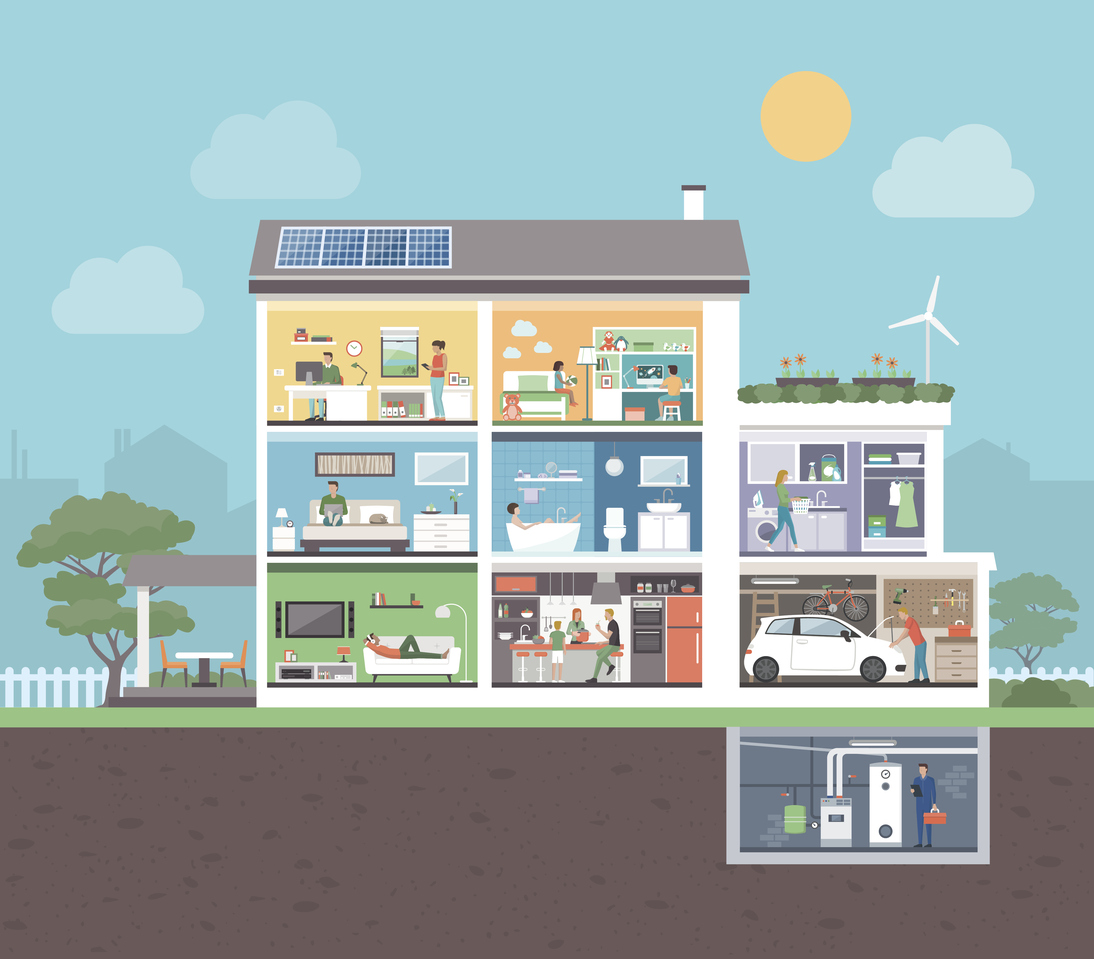
Towards efficient and sustainable home heating

superadmin
March 6, 2017
Passive houses, thanks to the incorporation of an efficient ventilation system, are the paradigm of the trend towards eliminating the air conditioning system. In this article, we explain how to enjoy a low-consumption cooling system and efficient home heating without giving up the comfort and well-being that your family needs.
The European Union and NZEB
The Passivhaus standards require a heating and cooling demand that does not exceed 15 kwh/m2•a (with an installed thermal power of about 10w/m2). This forces a reconsideration of the current air conditioning model of our buildings, which is based on the dry temperature of the environment and ignores such an important parameter as user comfort. To comply with the guidelines of the European Union, which promote Nearly Zero Energy Buildings (ECCN or NZEB, the acronym in English), we must enhance the use of efficient ventilation systems to the detriment of conventional heating systems.Video on renewable energies and their impact to achieve low-energy home heating
An efficient home heating system
The best way to provide your home with efficient and environmentally friendly heating is through the installation of a controlled mechanical ventilation dual-flow system. Do you know how it works? In a dual-flow VMC system, the entire air renewal process occurs mechanically, both the intake (supply of fresh, clean, impurity-free air with adequate relative humidity) and the extraction (expulsion of used air as a result of human activity in the premises). Thanks to the high-efficiency heat recoverers of the equipment, we can recover up to 90% of the energy, as the air is supplied at a temperature of 21°C, so no extra energy supply is needed to heat it, and it is not at the mercy of the outside temperature.Some observations about the heat exchanger
- To avoid thermal losses and the appearance of condensations, it is necessary to ensure that the ducts are properly insulated.
- If we want the ventilation system to act as a heating system, we must ensure that the ductwork can transport air at high temperatures (approximately 50°C)
Since in summer the temperature difference is lower (and, consequently, the recovery rate is also lower), it is advisable to install a by-pass in the heat recovery unit, so that it is possible to adjust the equipment to better take advantage of the effects of ventilation during the night (which is when the outdoor air temperature is lower than the indoor air temperature).
Soil-air exchanger
Inspired by the “Canadian well” and the “Provençal well”, a soil-air exchanger is a buried duct responsible for transporting air (air that replaces the air that would come in from the outside of a building to the inside). Through this system, the replacement air is tempered before being blown into the energy recovery unit, thanks to thermal exchange with the ground (whose temperature, not subject to climatic changes, is more stable than the exterior). Conventional heating and cooling systems, due to their high energy demand, considerably increase the ecological footprint of the real estate sector (the energy demand of families represents more than 50% of annual energy expenditure). There are currently efficient ventilation systems that can help reverse this situation, let's not wait until it is too late.

Siber Ventilation
Manufacturer of High Energy Efficiency Ventilation Systems. Siber provides a set of high energy efficiency solutions in wind and mechanically intelligent ventilation, improving the Health, Hygiene, and Comfort of people, being respectful of the environment.