Heat recovery in ventilation, how does it work?

superadmin
June 13, 2018
In efficient air conditioning, one of the most important aspects is heat recovery in mechanical ventilation. It is a way to ensure the necessary comfort in our homes, businesses, or offices without incurring the large costs of traditional air conditioning. If we greatly simplify its functionality, we can say that it is a thermal exchange or heat recovery system that allows heating or cooling the outdoor air - depending on whether it is summer or winter - to make use of energy previously consumed.
The heat recovery units make energy expenditure much lower and, in many cases, null. This is why passive houses of Passivhaus and other sustainable certification labels like BREEAM have opted for ventilation systems with a heat recovery unit.
Looking ahead to the imminent future of construction, in the Nearly Zero Energy Building -which will be launched on a large scale within a year and a half-, ventilation systems with heat recoverers will be almost a necessity. Thanks to this, it is possible to enjoy a cool climate in summer and a more temperate temperature indoors in winter. Without the need to use air conditioning devices or heating systems.
There are several ways to classify heat recoverers. Some only recover sensible energy while others recover both sensible and latent energy. The recovery units that are routinely installed in mechanical systems are the latter.
How do these heat recovery units in ventilation systems work?
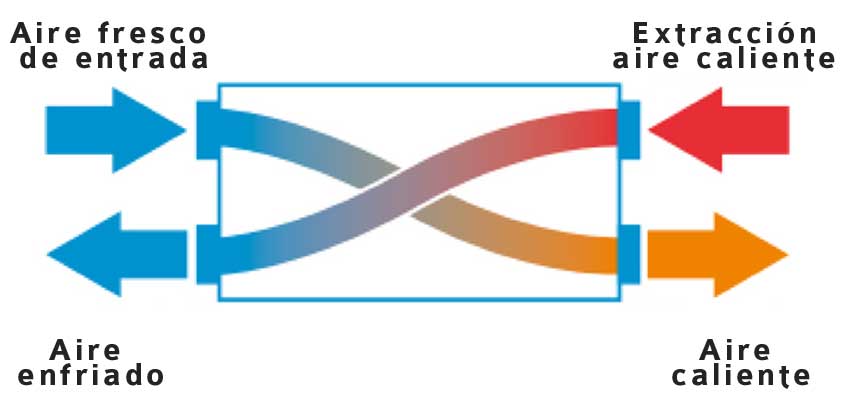
Basically, they are capable of recovering the air conditioned from inside a room - regardless of whether it is cold or hot outside - thanks to the use of the temperature and humidity of the air indoors.
Suppose the air inside a room is above 20°C and it is winter. At the moment of renewing the indoor air, to prevent cold air from entering, the recoverer contacts the air extracted from the rooms with the air coming from outside. In this contact, the air does not mix, but rather the input and output circuits are connected to heat the incoming cold air.
In this way, the temperature and humidity of the air being exchanged are utilized. The cold air that enters from the street will be heated in winter, and in summer it will be the other way around: the warm air from the hot months will be cooled as it passes through the exchanger.
What do we achieve?
- A significant energy saving. Unless we are in extreme cold or heat situations, comfort at home will be more than sufficient.
- The air entering the home is clean and filtered. Free of impurities, contaminating particles, and even insects.
Another element that notably influences the efficiency of the recoverer itself is the ventilation flow. Where should these units be installed?
- They can be mounted in the false ceiling and in a horizontal position.
- There are installations both vertically and horizontally.
Aerothermal energy in heat recovery
In heat recovery, passive houses - which are called that because they almost have no energy consumption - use mechanical ventilation systems that make use of aerothermal energy. This heat recovery system makes it possible to temper a room and have up to 78% of that energy be free.The aerothermal system extracts the energy contained in the outside air to convert it into heat inside the home, technically known as refrigeration method. The system even works when the outside temperature is below zero.
When the weather conditions are extreme, aerothermal systems and other heat recovery systems opt for using electricity. It is always cheaper than using combustion systems.
In the future of ventilation, heat recovery systems will be very common because, as we previously mentioned, Nearly Zero Energy Building forces builders to seek solutions of this nature. They can temper rooms without needing to use traditional technologies.

Siber Ventilation
Related posts