
What are air filters and what types exist?
superadmin
April 28, 2023
Air filters have become indispensable tools for sanitizing the environment and improving its safety. What's the reason? They manage to trap most of the bacteria and suspended dust and pollen particles. However, not everyone is clear on how they work. Below, we will explain it in detail.
What are air filters and what function do they serve?
Air filters are devices designed to improve indoor air quality. As we will see a little later, there are several types, but they all serve the same function: to eliminate impurities present and provide cleaner, purer air.
 But what are the particles that deteriorate the air quality of an enclosed space? These are the most common:
- Fumes from tobacco use or cooking.
- Pollen and dust particles, which are the cause of many allergic reactions.
- Dust mites and other microorganisms.
- Mold and spores.
- Bacteria responsible for respiratory infections and other diseases.
- Virus particles.
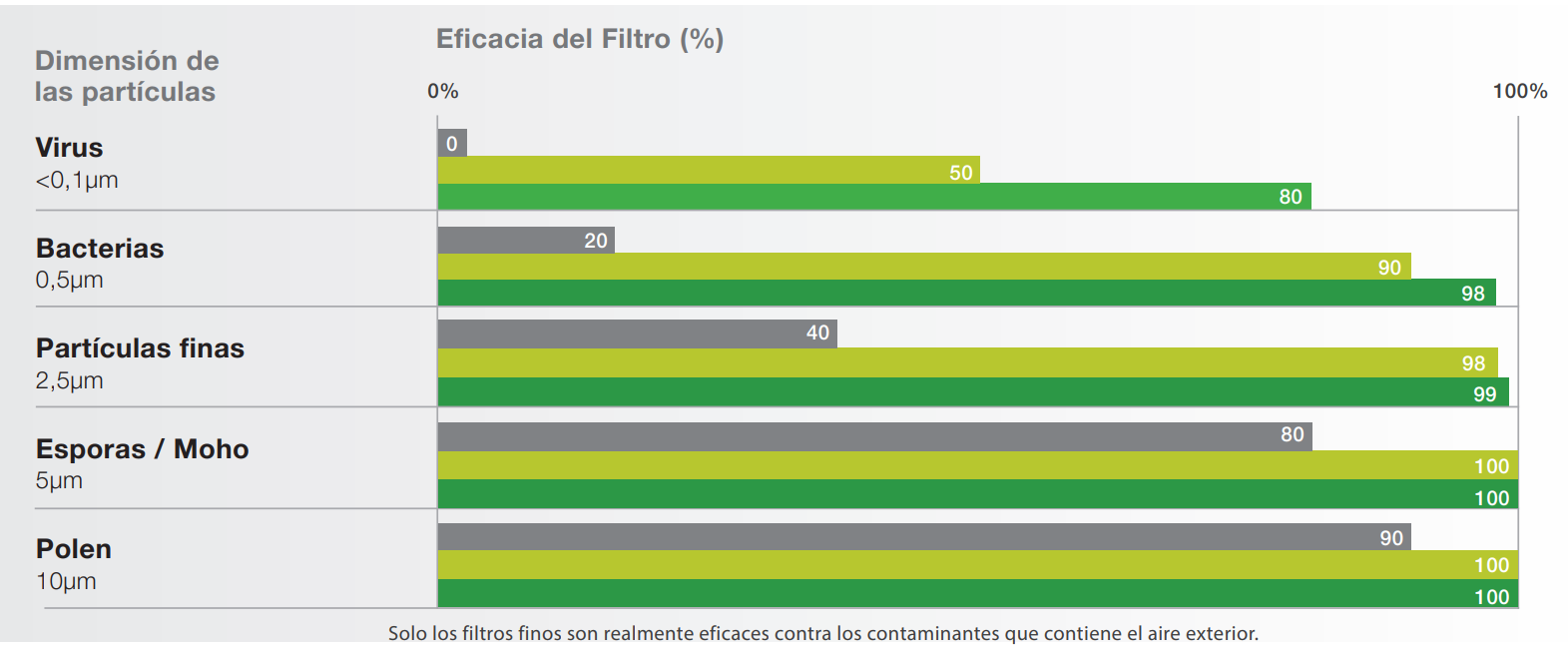
The problem with these harmful elements is that they have a very small size. Our body is prepared to naturally filter particles larger than 10 microns (µm), but it is not effective against smaller ones.
Fortunately, the best air filters currently available can retain particles as small as 0.03 µm. This means they offer an effectiveness that approaches 100%.
What types of air filters exist?
In the market, we can find mainly five types of air filters:
- Activated carbon filters. The most useful for eliminating bad odors and virus and bacteria particles. For this reason, they are usually installed in most air recirculation systems.
- Wet filters. In this case, the filter media is soaked with an oil responsible for retaining contaminating agents. It is very effective against dust and pollen.
- Dry filters. They work the same as the previous ones, but using a fiber mesh through which airborne contaminants cannot pass.
- Electrostatic filters. Their main advantage is that they do not reduce air flow in the slightest. This is because they work with a series of magnetized electronic plates that attract particles. They are highly recommended against tobacco smoke and soot.
- HEPA filters. They became especially popular during the COVID-19 pandemic, as health authorities recommended their use due to their high efficiency. They are the only ones capable of retaining particles of 0.3 µm in diameter, among which are almost all present in the air.
What happens if the air filter is dirty?
First, it loses efficiency. That is, the air filter will not be as effective in retaining contaminants present in the environment. However, this is not the only problem associated with dirt.
Moreover, the airflow will be reduced, as accumulated particles will obstruct the path. This will also force the ventilation system's motor to make a greater effort to maintain stable flow. In this way, energy consumption will increase and the system's lifespan will be reduced.
Therefore, periodic cleaning of air filters is essential to guarantee their effectiveness over time. Moreover, it is usual to have to replace them after a certain period. To know more about this, we invite our readers to take a look at our article Ventilation system filters: current regulations and uses.


Siber Ventilation