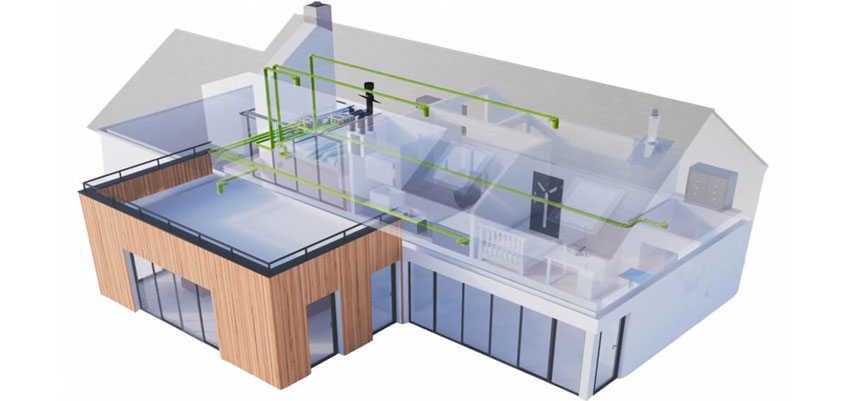
The evolution of the different types of forced ventilation

superadmin
April 27, 2017
Differences between natural ventilation and forced ventilation
Traditionally, for the renewal of indoor air in homes, natural ventilation has been used in any of the three schemes through which it can occur: unilateral ventilation, cross ventilation, and vertical suction ventilation. In any of these, the renewal of indoor air occurs due to the pressure and temperature difference between the outside and the inside of the building. However, from an energy-saving point of view, natural ventilation is not considered an efficient system. Therefore, it is also not included within the Technical Building Code as a general ventilation system, but it is established in Basic Document HS3, "Indoor Air Quality" that homes must have a general ventilation system that must be hybrid or mechanical.The hybrid ventilation is the one that performs natural indoor air ventilation when environmental pressure and temperature conditions are favorable and uses mechanical extraction when they are not. Forced ventilation or mechanical ventilation is generated by the operation of electromechanical equipment designed and installed to renew indoor air.
Evolution of ventilation systems in recent decades
Mechanical ventilation systems have evolved from mixed or hybrid systems, where mechanical extraction is combined with the admission of air by natural means and vice versa. Over the last three decades, the most widespread ventilation system in our country has been the system that combines the intake of air into the home in a natural way with the extraction of the same through mechanical systems. The admission of fresh air is done through adjustable grilles located on the facade. The extraction of contaminated air is done through an extractor connected via ducts to humid areas (bathrooms, kitchen, and toilets), which conducts it outside. The installation of this system is quite simple but has the drawback that outside wind decreases comfort and significantly increases energy consumption. In general, they tend to greatly limit the acoustic insulation of the home regarding the outside. For these and other reasons, the mixed system has been progressively replaced by ventilation systems with mechanical admission and extraction.Among these, it is worth highlighting the double flow systems with heat recovery due to the energy savings they provide. By using a thermal exchanger that manages to recover 92% of the extracted heat, the heat from the dirty air extracted from the home is recovered and transferred to the clean air coming from outside. In summer, this process is reversed, and the new air entering the home is cooled thanks to the temperature transfer that is carried out through the extracted air. In this way, when the outside temperature is 30ºC and the inside is at 21ºC, the new air is introduced at 22ºC, refreshing the environment.


Siber Ventilation
Related posts