Decentralized ventilation at home, how does it work?

superadmin
April 17, 2019
The mechanical ventilation systems are the best way to renew the air indoors and to enjoy high quality of what we breathe. In addition, they can improve the energy efficiency of our home and also blow in hot air in summer and cooled air in winter. Among the mechanical systems, the decentralized double-flow ventilation is a great option for those homes or buildings where it is not possible to have a centralized installation, such as those properties that are in the process of being renovated. The decentralized ventilation is, in the case of home renovations, perhaps the best option for air renewal.
The double-flow mechanical ventilation is the most advanced solution for renewing the air indoors. Its operation consists of automatically introducing clean air into the rooms and extracting the air that has lost quality from them. In addition to achieving the best quality of breathable air indoors - all the air introduced is previously filtered - it is possible to improve energy consumption in the home. It is possible to recover heat in winter and introduce hot air in cold months and cooled air in summer, making it a high energy efficiency solution.
In the mechanical systems of double-flow ventilation we can make a separation based on its central unit:
- Centralized double-flow ventilation. In these cases, all the air that is collected from outside to be introduced is done from the same point. Then, that air will be distributed among the various rooms through a network of ducts, which will go to the so-called dry areas, the bedrooms and the living rooms. The extraction - which occurs in wet areas such as bathrooms and kitchens - will also be carried out through a network of ducts that will then extract the air outside the property. All this is controlled with a central unit.
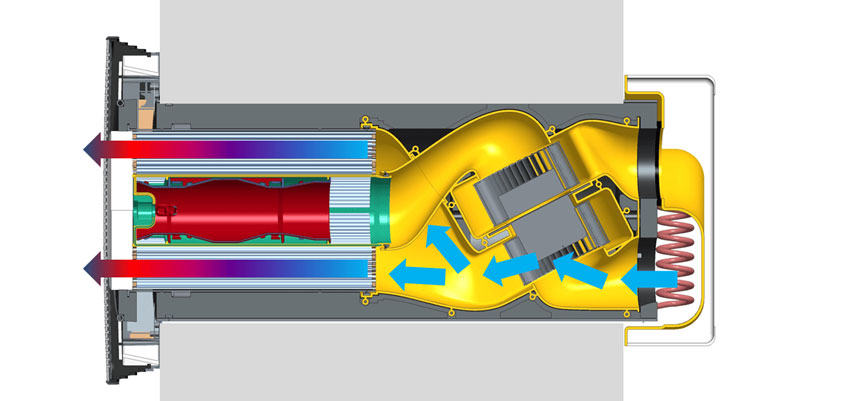
- Decentralized double-flow ventilation. In this case, all the extraction and admission units operate separately, and they have their own independent control equipment, although they can be independent units that both introduce and expel air. For example, if we install an admission and extraction unit in a room, it will connect directly between the outside and the inside. Within the same equipment, a filter will be included to clean the air and also the fan, and it can both extract stale air and introduce renewed air.
However, if we are carrying out an installation in a property for remodeling, then a decentralized double-flow ventilation solution may be interesting, as it will be much easier to install. It will only be necessary to find a zone that connects the interior with the exterior. Although it will not be centrally controlled and the fans will be closer to the commonly used rooms, there are ventilation solutions that generate very little noise and provide remarkable results.
Benefits of decentralized double-flow ventilation

As we have mentioned, the decentralized ventilation has separate units that can offer us the necessary air renewal, in addition to better energy efficiency in our homes. Due to its simple installation, they are an option to consider in home remodeling projects.
Some of its benefits are as follows:
- There are independent solutions that can cover spaces of up to 70 m3/h of air renewal.
- A single air intake is used for the entry of renewed air and also for the expulsion of stale air, hence less installation is required.
- It is the ideal system for rehabilitation works.
- The heat exchangers are removable for easier maintenance.
- The fan motors are low consumption and also silent.
- Through a heat exchanger, up to 80% of the temperature of a room can be recovered, significantly reducing the air conditioning needs.
- Quick assembly and disassembly. In addition, it does not clash with the home's appearance.
- By-pass systems for nighttime cooling.

Siber Ventilation
Related posts

Constant flow ventilation systems, how do they work?